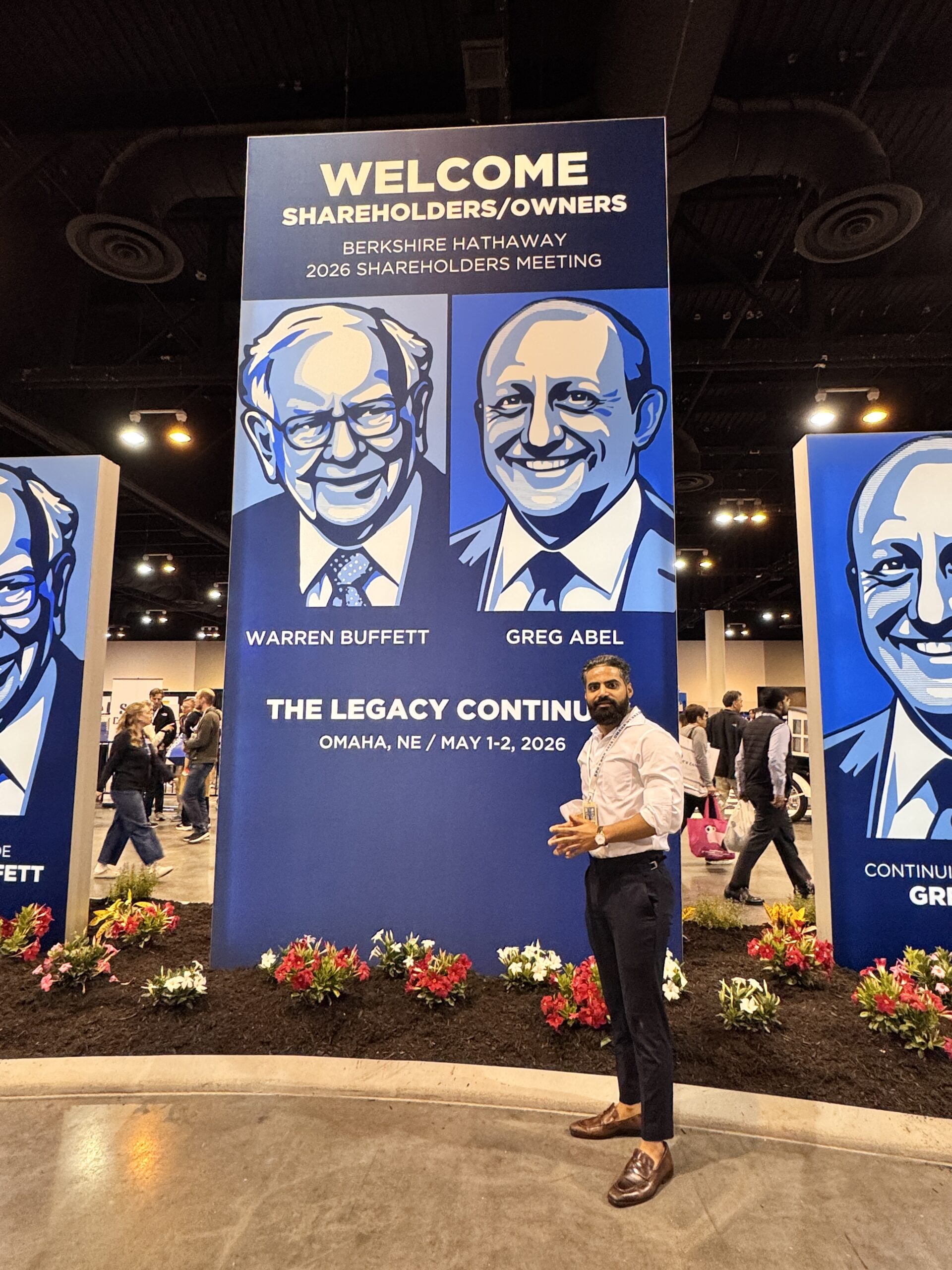
A lot to unpack from the weekend in Omaha! From a chance encounter with Li Lu to meeting all the bright minds at various events.


The who’s who you randomly run into at this place is mind boggling – Bill Ackman, Mohnish Pabrai, Guy Spier, Li Lu, Chris Bloomstran, Tim Cook – are regular attendees.
This was the first time Greg Abel lead the meeting from the stage and Warren sat in the audience. A couple of things stood out to me.
The Jobs-to-Cook parallel is hard to ignore
Watching Greg Abel run his first annual meeting as CEO, the parallel to Apple’s leadership transition kept hitting me. Warren and Steve Jobs were exceptional communicators and visionaries — the kind of founders who could sell a room on a story, not just a business. Greg and Tim Cook are something different: exceptional operators. People who make the machine run better, not people who built the machine’s mythology.
That’s not a knock on either side. It’s just a different skill set, and Berkshire is about to find out what happens when you swap one for the other.
Where Warren’s alpha actually came from
Warren’s edge was never operational. It came from capital allocation — knowing where to put money and, just as importantly, where to stop putting it. He was famous for delegating to the point of near-abdication, letting subsidiary managers run their businesses with almost no oversight from Omaha. That worked beautifully when the subsidiary was strong. It worked less well when a business started decaying, because Warren’s instinct wasn’t to roll up his sleeves and fix it — it was to stop feeding it capital and redeploy elsewhere.
That’s a perfectly rational strategy for an investor. It’s a less satisfying one if you’re a shareholder in a subsidiary that’s quietly losing share while corporate looks the other way.
Where Greg changes the equation
This is where I think the Abel era gets interesting. He’s not a capital allocator by trade, he’s an operator, and operators tend to actually engage with underperforming businesses instead of just starving them.
Look at BNSF and Geico. Both have coasted for years without seriously competing on technology against sharper rivals — Union Pacific on the rail side, Progressive on the insurance side. Under Warren’s model, that gap either gets fixed by the subsidiary’s own management or it doesn’t get fixed at all. I’d bet money that changes under Abel. He’s already talked about using Berkshire’s balance sheet and operating discipline more actively, and a $397 billion cash pile sitting around only makes sense if you’re either going to deploy it into something big or invest it back into sharpening the businesses you already own.
Some of that shift was visible even in the small stuff this year — Abel fielding an AI deepfake question from a fake “Warren,” and using it to talk through how Berkshire actually thinks about AI (“not doing AI for the sake of AI”). Small moment, but it’s the kind of thing that signals a management team thinking about competitive positioning in a way the old regime rarely bothered to perform in public.
The stock should follow the operator
Greg Abel might just be Berkshire’s Tim Cook moment — the transition from a legendary allocator to a disciplined operator who finally makes the underperforming pieces of the portfolio compete like they’re supposed to. Apple’s stock didn’t suffer when Cook took over; if anything, operational rigor unlocked value Jobs never bothered to chase. I think Berkshire is set up for a similar story.
The vision built the empire. The operator is going to be the one who makes it hum.
Get freshly brewed hot takes on Product and Investing directly to your inbox!
Leave a Reply