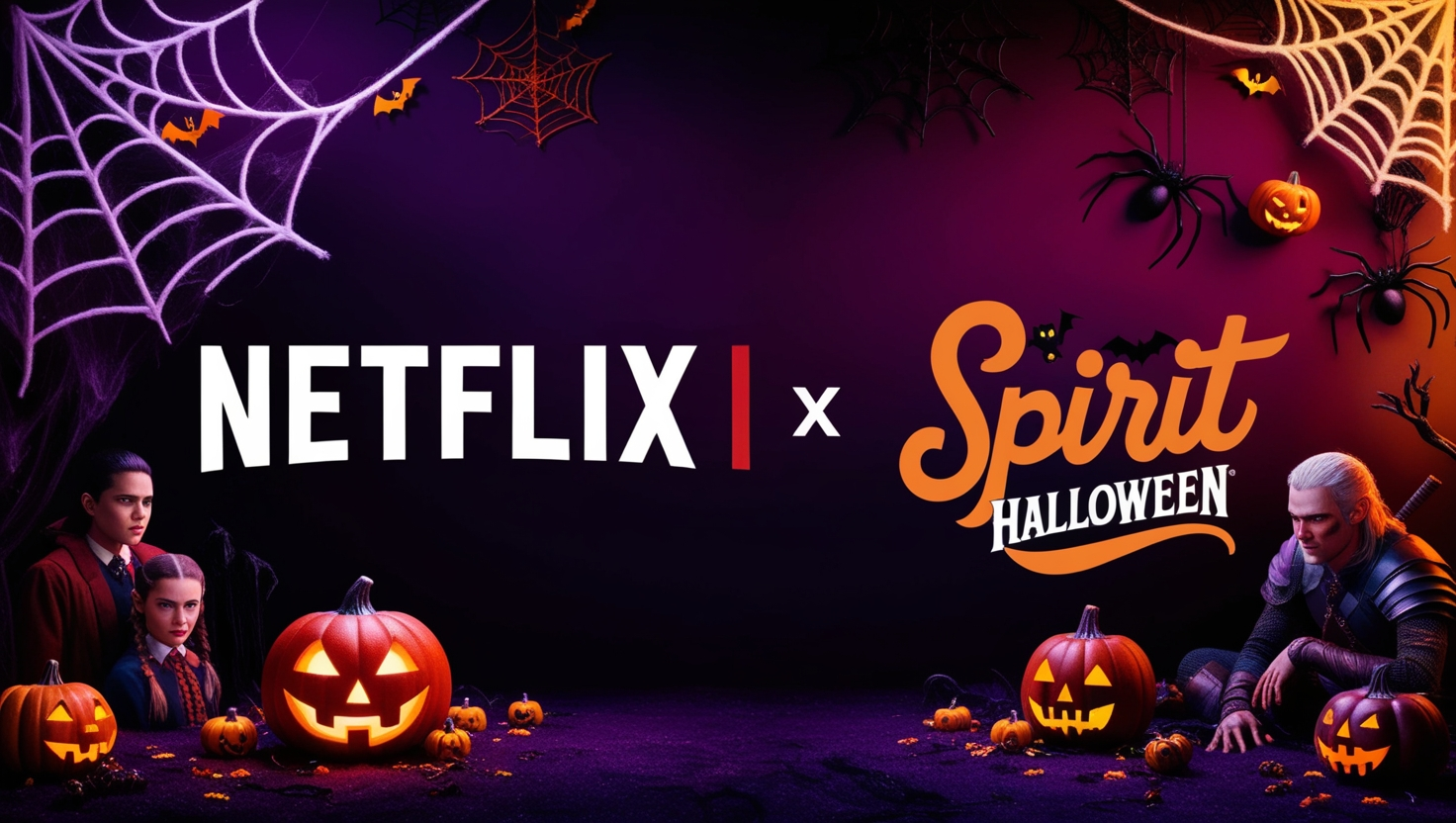
I’ve had an idea stuck in my head for last few weeks: Netflix should buy Spirit Halloween.
Yes, that Spirit Halloween. The orange-banner pop-up that moves into an empty Party City every August and is gone by the first week of November.
The more I looked into it, the more sense it made. Netflix makes the shows people want to dress up as. Spirit sells the costumes. And Spirit is about as light as a business with 1,550 physical stores¹ can get, because it only rents most of them for around three months a year².
As far as I know, nobody is actually working on this deal. I just wanted to think through why it could work, what Spirit is probably worth, and where the idea falls apart.
Why I keep coming back to Disney
When I think about who Netflix is really up against among media companies, it’s Disney. And the part of Disney that worries me most, from Netflix’s point of view, is the parks.
Disney’s Experiences segment covers the parks, the cruise ships and consumer products. Over the last four quarters Disney has reported (July 2025 through June 2026), it brought in $38.2 billion³⁴⁵. That’s about 39% of Disney’s $98.9 billion in total revenue. Over the same twelve months, all of Netflix brought in $48.4 billion⁶. So one Disney division is roughly four-fifths the size of the entire company.
| Last 12 months (Jul 2025 to Jun 2026) | Revenue | Operating income | Operating margin |
|---|---|---|---|
| Disney Experiences³⁴⁵ | $38.2B | $10.8B | 28% |
| Netflix⁶ | $48.4B | $14.4B | 30% |
| Netflix, 2026 full-year forecast⁶ | $51.1B | ~$16.1B | 31.5% |
I used that window because Disney’s fiscal year ends in early October, and it won’t report full-year fiscal 2026 until mid-November. I added up Disney’s quarterly results and Netflix’s quarterly results for the same twelve months.
I went in assuming Netflix would have far better margins than a theme park operator. They’re actually pretty close: 28% for Disney’s parks versus 30% for Netflix over the past year. Netflix expects to get to 31.5% for 2026. Where the two really differ is how much money they have to sink into the ground. Disney has committed roughly $60 billion over ten years to parks and cruise ships⁷. Netflix has never had to spend anything close to that on physical stuff.
What Disney gets for all that money is staying power. Mickey Mouse is almost 100 years old. Kids still want to be Cinderella, Aladdin, and Jack Sparrow decades after those movies came out. I think the parks have a lot to do with that. A kid meets Cinderella, rides Pirates of the Caribbean, goes home in the merch and is first in line for the sequel. After a trip like that, those characters are part of the kid’s own memories.
Netflix has a harder time with this. It puts out massive hits like Squid Game, Wednesday, and Stranger Things, each one everywhere for a few months, and then the conversation moves on. There isn’t much in the real world pulling people back to those characters once the season’s over.
What Netflix has tried so far
Netflix clearly sees this too, and it’s been dipping its toes in. By mid-2025 it had run more than 50 live experiences in 25 cities⁸. Two of them stand out to me:
- A themed restaurant that started out as a six-week pop-up in Los Angeles in 2023, called Netflix Bites. In 2025 it got a one-year run at the MGM Grand in Las Vegas.⁸
- Then there’s Netflix House, which is much bigger. These are permanent venues of more than 100,000 square feet in old department stores. The first two are in King of Prussia, near Philadelphia (opened November 12, 2025), and Galleria Dallas (December 11, 2025)⁹. A third, on the Las Vegas Strip, is due in 2027¹⁰. Getting in is free, and Netflix makes its money on ticketed experiences, food and merch.
I like both of these, but they’re small. Three venues will only ever reach a sliver of Netflix’s 325 million paid memberships¹¹, and you have to travel to get to them. Spirit already has a store in a strip mall near pretty much everyone.
The timing is interesting too. In December 2025 Netflix agreed to buy Warner Bros. and HBO Max for about $82.7 billion including debt¹², which would have handed it a huge library of characters people already love. That fell apart on February 27, 2026, when Warner Bros. Discovery went with Paramount Skydance instead, and Paramount paid Netflix a $2.8 billion termination fee¹³. So Netflix can’t buy a century’s worth of characters. It has to find ways to make its own last longer, and owning the store where people buy their costumes seems like a pretty good way to do that.
How much Americans spend on Halloween
Before getting into Spirit’s numbers, it helps to see how big Halloween has gotten. The NRF expects Americans to spend $13.5 billion on it this year, up from a record $13.1 billion in 2025¹⁴. Back in 2021 it was $10.1 billion¹⁶.

A few other things from this year’s NRF survey jumped out at me¹⁴:
- 74% of Americans plan to celebrate, and 50% plan to dress up in a costume.
- The average person expects to spend $115.14, up from $103.63 in 2024¹⁵.
- Costumes are the biggest category at $4.4 billion: $2 billion on adult costumes, $1.5 billion on kids’ costumes and $920 million on pet costumes. Decorations come in at $4.3 billion and candy at $4.1 billion.
- 32% of shoppers plan to buy from a specialty Halloween or costume store, which is basically Spirit’s category. Discount stores are first at 39%, and online is at 27%.
- 49% start shopping in September or earlier, compared with 34% in 2016¹⁷. That lines up nicely with Spirit opening its doors in August.
The stat I keep thinking about is where people get their costume ideas. Online searches are the top source at 32%, and stores and costume shops come next at 26%¹⁴. My guess is that a lot of those searches start with something people just watched. Netflix is where the idea gets planted, and Spirit is where people go to buy it.
So what is Spirit actually worth?
Spirit is private, so there are no official numbers. From what I could find, it probably brings in somewhere around $1.0 to $1.2 billion a year, and nearly all of that comes in over about ten weeks.
Spirit is owned by Spencer Spirit Holdings, the same company behind Spencer’s, the mall store you probably remember from high school (it has about 600 locations)¹⁸. Spencer’s bought Spirit back in 1999, when it had only 60 seasonal stores. Management has owned the whole thing since buying out the private equity firm ACON in 2015. And in August 2026 the parent agreed to buy Hot Topic, BoxLunch and Her Universe from Sycamore Partners for a reported $350 million¹⁹. Put together, that’s more than 3,000 stores.

What I find impressive is how steady that growth has been. Spirit still opened 1,400 stores in 2020, in the middle of the pandemic²⁰, and it has grown right alongside the big-box bankruptcies that keep leaving empty buildings behind.
Revenue is harder to pin down. The estimates I found are all over the place:
| Source | Estimate | What it covers | My take |
|---|---|---|---|
| Moody’s, via Fortune²¹ | ~$1.9B (2023) | Spencer’s and Spirit together, with Spirit the bigger piece | The one I trust most, since credit agencies see the real financials |
| ZoomInfo²² | $978.6M | Spirit alone | Plausible, though they don’t say how they got it |
| Growjo²³ | ~$2B | Spirit alone | Seems high to me. It’s based on headcount |
| ECDB²⁴ | $163M (2025) | Online sales at spirithalloween.com only | Handy for sizing the online piece |
I wish I had something newer than 2023, but the Moody’s estimate is the most recent figure from anyone who has seen Spirit’s books, so I’m using it as my starting point. If Spirit is the bigger half of $1.9 billion, it made at least $950 million in 2023. Add a few more years of store openings and you land somewhere around $1.0 to $1.2 billion for 2026.
I also tried to work out what a single store does. Start with $1.1 billion, take out roughly $165 million in online sales, and split the rest across about 1,500 stores. That comes to something like $600,000 to $650,000 per store per season, or around $60,000 a week. Pretty good for a store that wasn’t there in July.
If Spirit is doing $1.1 billion, it’s getting around 8 cents of every Halloween dollar Americans spend this year¹⁴, while competing with Walmart, Target, Amazon and what’s left of Party City.
I should say these are my own rough numbers, pieced together from outside estimates, so I’d treat them as ballpark figures.
Why the business is so light
My favorite thing about Spirit’s model is that it only pays for stores when people actually want to shop in them. Once Halloween is over, it hands the buildings back.
It goes after short leases in empty buildings. Spirit’s ideal lease is about three months long, with a clause that lets it leave early if the landlord finds a permanent tenant². A lot of its 2026 stores are old JoAnn, Big Lots and Party City locations. The landlord gets some rent on a space that would have been sitting empty, and Spirit gets a store without paying for it the other nine months of the year.
Its timing helps too. Most retailers sign their leases early in the year, so by midsummer, when Spirit starts looking, there isn’t much competition for whatever’s left²¹.
Then it moves fast. Spirit can turn an empty box into a working store in as little as 30 days. Almost all of this year’s stores close on November 2, and Spirit planned to hire 52,000 seasonal workers in 2026, its biggest hiring push ever². Most stores are open for 60 to 90 days, and some even get a second life as Spirit Christmas pop-ups after Halloween²⁰.
What Spirit keeps all year is the know-how: picking sites a year ahead, running the supply chain, designing exclusive products, and a brand everyone recognizes. That’s really what Netflix would be paying for. I’ll admit the parent company isn’t quite as light as Spirit, though. Spencer’s and now Hot Topic run year-round mall stores. And Spirit has to order its costumes months before anyone knows which show is going to take off.
Why I think it would work
This is the part I care about most. On Halloween I want to see my family and friends dressed up as whatever Netflix show everyone’s been watching that fall, and I want those costumes to actually be on the shelf.
KPop Demon Hunters is a good example of what goes wrong today. It came out in 2025 and became Netflix’s most popular original movie ever. That October, the top five most-searched Halloween costumes on Google were all characters from it²⁶. Spirit had the only officially licensed costumes, at $59.99 for kids and $69.99 for adults²⁵, and they sold out. Netflix told Business Insider that licensing partners had been pretty lukewarm before the movie came out (Netflix’s word was “soft”), so not many were made²⁶. A lot of parents ended up ordering knockoffs from TikTok Shop, and Netflix didn’t see a cent from those.
If Netflix owned Spirit, it could fix exactly that. A licensing partner has to guess which new show will hit. Netflix can see what people are watching and rewatching before anyone else does, so it could order inventory early, put its characters front and center in the store, and even schedule its spooky releases for August, right when Spirit opens its doors.
Look at the NRF’s list of top costumes for 2026¹⁴. It’s Spider-Man and Batman, plus witches, vampires and ghosts. Marvel and DC both made the list, and no Netflix character made the top five for kids or adults. That pretty much sums up the problem.
My one liner pitch would be:
Netflix makes the characters people want to be. Spirit Halloween would give it the mindshare when they decide who to be at the most important time of the year – Halloween.
How Netflix could grow Spirit’s revenue
Owning Spirit only makes sense if Netflix can make it bigger, so I tried to put rough numbers on how that could happen. Starting from my estimate of about $1.1 billion a year, these are the places I think the extra money would come from:
| Lever | What changes | My rough guess at extra revenue per year |
|---|---|---|
| Stocking Netflix hits properly | Netflix’s viewing data tells Spirit what to order deep, so the next KPop Demon Hunters doesn’t sell out. Say that wins Spirit 2 more points of the $4.4 billion US costume market¹⁴ | ~$90M |
| Netflix-themed décor | Decorations are a $4.3 billion category¹⁴. Think Stranger Things and Wednesday animatronics and yard displays, worth one more point of share | ~$45M |
| Promoting Spirit on Netflix | From August through October, Netflix can promote Spirit to its US members at basically no cost. Say that grows Spirit’s $163 million online business²⁴ by 25% | ~$40M |
| Selling to fans outside North America | Netflix says its audience is approaching one billion people⁶, but about 95% of Spirit’s online sales are in the US²⁴. Say international orders reach a quarter of today’s online sales | ~$40M |
| A bigger Spirit Christmas | Spirit Christmas had about 30 stores in 2025²⁰. Netflix holiday titles could justify 150, at roughly $200,000 per store for the season | ~$25M |
| Total | ~$240M a year, or about 22% growth |
That’s a lot of guessing, so I’d take the total with a grain of salt. Even half of it would mean an extra $120 million a year, though. And it doesn’t count the profit side. Today Spirit pays Netflix a licensing fee on every official costume it sells²⁶. After a deal, that money would just stay in the family.
What it would cost
Spirit isn’t going to be sold on its own, so Netflix would probably have to buy the whole parent company. My rough math is below. The margins and valuation multiples are my own guesses, based on how specialty retailers usually trade:
| Scenario | Revenue | EBITDA margin (my guess) | EV/EBITDA (my guess) | Rough value |
|---|---|---|---|---|
| Spirit alone, low end | $1.0B | 12% | 6x | ~$0.7B |
| Spirit alone, high end | $1.2B | 18% | 9x | ~$1.9B |
| Whole parent, including Hot Topic | ~$2.5–3.0B | 10–13% | 7–9x | ~$1.8–3.5B |
Even at the high end, that’s small money for Netflix. Over its last four reported quarters (October 2025 through September 2026), it made $15.6 billion in operating income, and it expects about $16 billion for 2026 as a whole⁶. The $2.8 billion Paramount paid it to walk away from Warner Bros.¹³ would cover most or all of a deal like this. Netflix was ready to pay $82.7 billion, debt included, for Warner Bros.¹² This would be roughly 2 to 4% of that.
Again, those valuations are my back-of-the-envelope estimates, so don’t read them as reported figures.
Where this could go wrong
I don’t want to pretend this is a slam dunk. There are some real problems with it.
The biggest one is that Spirit makes most of its money selling other studios’ characters. This year’s stores are full of Spider-Man, Toy Story, Fortnite and Michael Myers¹. If Netflix owned the place, I could easily see Disney and Paramount (which now owns Warner Bros. and DC²⁷) taking their best licenses somewhere else, or at least driving a much harder bargain.
Retail margins are also thin. Netflix posted a 34.6% operating margin in its most recent quarter and expects 31.5% for 2026 overall⁶. A costume retailer probably earns something in the low teens. Even if the deal is small, investors might not love what it does to the overall numbers.
Then there’s inventory. Costumes get ordered months in advance. Netflix’s viewing data would help a lot, but if a show flops, somebody is stuck with pallets of capes nobody wants.
The strongest argument against all this is that Netflix could just partner instead. It already licenses costumes to Spirit. A multi-year exclusive deal with guaranteed inventory, or a minority stake, might get Netflix a lot of the benefit without owning any stores. I’ve gone back and forth on this one. Where I land is that partners mostly bet big on hits that are already proven, and the merch money Netflix leaves on the table usually comes from surprise hits like KPop Demon Hunters. Owning the retailer would let Netflix make that bet itself.
Where I land
For somewhere around $2 to $3 billion, which is about what Paramount just paid Netflix to go away, Netflix could own the place where a lot of America picks out its Halloween costume.
Disney spent decades and tens of billions of dollars turning its stories into places people visit. I don’t think Netflix has to follow that exact path. Spirit is a much lighter version of the same idea: 1,550 stores that show up right when people most want to dress up as someone else, and disappear when they don’t. Combine that with Netflix’s viewing data and its control over its own release calendar, and maybe next year’s most popular costume is a Netflix character instead of Spider-Man.
Selfishly, I’d love to see the kids in my family trick-or-treating as HUNTR/X and my friends as Wednesday and Squid Game guards, with every costume in stock. I know that alone wouldn’t justify a multibillion-dollar deal. But it’s a pretty good picture of what Netflix is still missing.
Sources
- Spirit Halloween 2026 season announcement, PR Newswire (Aug 18, 2026)
- Spirit Halloween opens 1,550 stores, then closes almost all of them, Inc. (Oct 16, 2026)
- Disney Q4 and full-year fiscal 2025 results, SEC filing (Nov 2025)
- Disney Q2 fiscal 2026 results, SEC filing (May 6, 2026)
- Disney Q3 fiscal 2026 results, Quartz via Yahoo Finance (Aug 5, 2026)
- Netflix Q3 2026 shareholder letter, SEC filing (Oct 20, 2026)
- Disney’s $60 billion parks plan, Spectrum News 13 (Sep 2023)
- Netflix opens restaurant on the Las Vegas Strip, Chain Store Age
- Netflix House opening dates, TheWrap (Aug 2025)
- Netflix House Las Vegas, Netflix
- Netflix Q4 2025 shareholder letter, SEC filing (Jan 2026)
- Netflix to acquire Warner Bros. in deal worth $82.7B, Built In (Dec 5, 2025)
- Warner Bros. Discovery 8-K on ending the Netflix deal, SEC filing (Feb 27, 2026)
- NRF 2026 Halloween survey, National Retail Federation (Sep 22, 2026)
- NRF 2024 Halloween survey, National Retail Federation (Sep 19, 2024)
- NRF 2022 Halloween survey, National Retail Federation (Sep 19, 2022)
- Halloween data and trends, National Retail Federation
- Spencer Gifts, Wikipedia
- Spirit Halloween parent to acquire Hot Topic, Retail Dive (Aug 7, 2026)
- Spirit Halloween, Wikipedia
- Spirit Halloween’s meme-worthy $2 billion business, Fortune and Morning Brew (Oct 27, 2025)
- Spirit Halloween company profile, ZoomInfo
- Spirit Halloween revenue estimate, Growjo
- Spirit Halloween online revenue, ECDB
- KPop Demon Hunters costumes at Spirit Halloween, Netflix Tudum
- ‘KPop Demon Hunters’ is a huge hit for Netflix. So where are all the Halloween costumes?, Business Insider via AOL (Oct 2025)
- Paramount completes Warner Bros. Discovery acquisition, Pulse 2.0 (Sep 22, 2026)
Get freshly brewed hot takes on Product and Investing directly to your inbox!

Leave a Reply