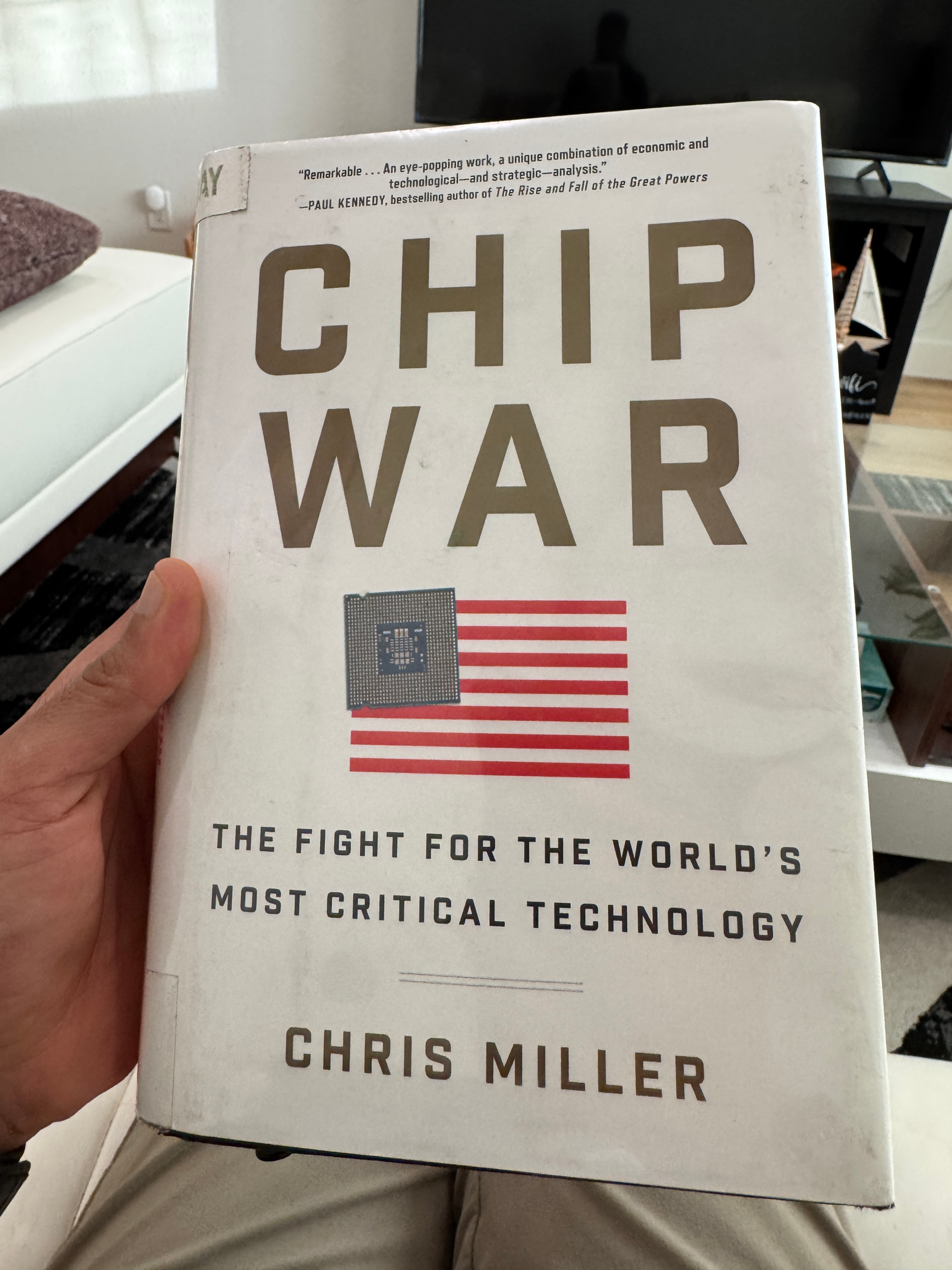
I just finished reading the book Chip War. It was one of the most interesting read that helped me understand the evolution of chip industry and silicon valley as we know it today. One story that stood out to me was the inception of much debated stock compensation in Silicon Valley.
Somewhere in a filing cabinet at the old Fairchild Semiconductor headquarters, there sits an exit questionnaire. Most such forms are forgettable HR paperwork. But this one, filled out by a departing engineer in the late 1960s, contained a line that would change capitalism itself. Under the question asking why the employee was leaving, five words were written in large block letters:
“I… WANT… TO… GET… RICH.”

It wasn’t a complaint. It was a manifesto. And it spoke for dozens — perhaps hundreds — of engineers who had built one of the most consequential companies in American history, only to watch its financial rewards flow to a billionaire owner 3,000 miles away on the East Coast.
The story of how that frustration reshaped Silicon Valley — and ultimately the global technology industry — begins with a semiconductor company, a stubborn patriarch, and a band of engineers who refused to accept that talent should go unrewarded.
The Company That Built Everything
To understand what was at stake, you have to understand what Fairchild Semiconductor was. Founded in 1957 by the “Traitorous Eight” — a group of brilliant defectors from Shockley Semiconductor Laboratory — Fairchild was ground zero for the modern tech world. It pioneered the planar transistor manufacturing process that made integrated circuits commercially viable. Without Fairchild, there is no Intel, no Apple, no Google, no smartphone in your pocket.
In the late 1960s, semiconductor companies had the same aura that AI companies have today: frontier technology, elite talent, and exponential growth curves. Moore’s Law — the famous observation by Fairchild’s Gordon Moore that transistor density would double approximately every two years — was in full swing. The future was being invented in those labs, and everyone knew it.
A rough timeline of events:

The East Coast Problem
Here was Fairchild’s fatal flaw: it was owned by an East Coast multimillionaire named Sherman Fairchild, heir to IBM fortune, who ran the company as a subsidiary of his Fairchild Camera and Instrument Corporation. He was not a bad man. He was simply a product of a different era and a different geography — one where equity was kept close to the chest, where employees were compensated with salary and prestige rather than ownership stakes, and where the gap between founders and workers was considered natural and permanent.
Sherman Fairchild refused to grant meaningful equity to Fairchild Semiconductor’s employees. The engineers, physicists, and visionaries who were literally inventing the future received wages while their employer captured the wealth. It was a compensation philosophy borrowed from traditional manufacturing — appropriate, perhaps, for a widget factory in Ohio, but catastrophically misaligned for a company whose value lived entirely inside its employees’ heads.
In a knowledge economy, talent IS the asset. The engineers at Fairchild weren’t assembling a product — they were the product. Their minds, their expertise, their willingness to solve unsolved problems: that was the source of Fairchild’s value. Any structure that failed to acknowledge this would eventually collapse under its own contradictions.
The engineers noticed. And they left.
The Great Exodus and What It Built
The story of Fairchild’s alumni is one of history’s great examples of talent redistribution. When the best people walked out the door — tired of watching their innovations make someone else rich — they didn’t just disappear. They founded companies. Many companies.
Fairchild’s alumni went on to found or co-found a staggering list of firms that defined the modern tech ecosystem: Intel (Robert Noyce and Gordon Moore), Advanced Micro Devices (Jerry Sanders), Kleiner Perkins (Eugene Kleiner, one of the original eight), National Semiconductor, and dozens more. The investor Don Valentine, who funded Apple and Atari, came from the Fairchild orbit. The intellectual lineage runs so deep that the startup world developed a phrase for it: Fairchildren.
The valley map of semiconductor companies in the 1970s was sometimes called the “Fairchild family tree” — a single trunk that branched into an entire ecosystem. The man who refused to share equity ended up incubating the competition that would eventually marginalize his own company.
The Backlash That Became a Philosophy
Here is where the story stops being merely interesting and starts being consequential. When the Fairchild defectors started their own companies, they did something deliberate and radical: they shared the equity. Intel, from its earliest days, granted stock options to employees across the organization. Not just the founders. Not just the executives. Engineers. Operators. People who had, at previous companies, always been on the wrong side of the wealth equation.
The logic was both moral and strategic. Moral, because the people creating value should share in the value created. Strategic, because in a world where your best engineers could walk out the door and start a competitor — as they had just demonstrated at Fairchild — the only sustainable way to retain talent was to make them owners.
Stock options became the instrument. An option grants the holder the right to buy company stock at a fixed “strike price” in the future. If the company grows, the stock price rises above the strike price, and the option becomes valuable. It costs the company nothing if the stock doesn’t perform. But if it does — if the team builds something great — everyone at the table participates in the upside. The employee’s interests and the company’s interests become identical.
The engineers who built the chips that built the world wanted a simple thing: to be treated as partners, not laborers. Silicon Valley eventually agreed.
This was not how businesses worked in 1968. In most of American industry, equity was the domain of founders, investors, and senior executives. The idea that a 26-year-old process engineer at a chip company might eventually become wealthy through stock options was genuinely novel. It felt, to East Coast business culture, vaguely improper — a blurring of the line between owner and employee that upset the established order.
Silicon Valley decided not to care.
The Lesson That Outlasted the Companies
Fairchild Semiconductor is gone now — absorbed and dissolved through a series of acquisitions, its name surviving only in history books and oral traditions. Sherman Fairchild died in 1971, never quite understanding what he had inadvertently set in motion. The company he controlled became the seed of an ecosystem that would generate more wealth than he ever could have imagined — almost none of which flowed to him or his heirs.
The engineer who wanted to get rich? We don’t know their name. History didn’t record it. But their five-word protest on an exit questionnaire contained a truth that East Coast capitalism hadn’t yet figured out: that in an economy where value is created by minds rather than machines, the old rules no longer applied. Talent, given the right conditions, becomes capital. And capital, as any businessman knows, deserves a return.
Silicon Valley heard that message. It built an entire civilization around it. And the rest of the world — slowly, reluctantly, and eventually completely — followed.
Get freshly brewed hot takes on Product and Investing directly to your inbox!
Leave a Reply