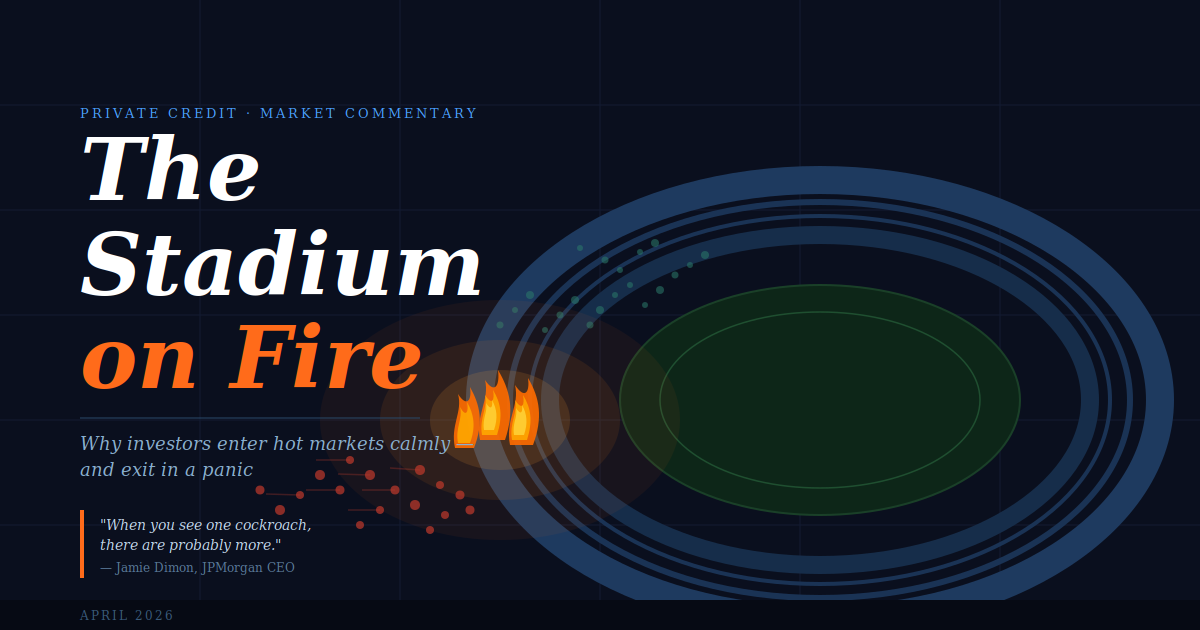
Picture a stadium on game day. Fans trickle in over hours — some arrive early to grab the best seats, others stroll in at halftime, and a few slip through turnstiles just before the final whistle. Entry is orderly. Unhurried. People choose their gates, their timing, their seats.
Now imagine a fire breaks out.
Nobody stops to ask where the fire is. Nobody checks how big it is, or whether it’s even heading their way. The exits fill instantly. People pour through every opening — the ones they came in through, the ones they didn’t, the emergency doors in the back. The only instinct is out, and fast.
“Entry is a choice. Exit is a reflex.”
This is one of the most accurate analogies I could come up with for understanding investor behavior in hot asset classes — and right now, it describes private credit almost perfectly.
The long, comfortable entry
Private credit spent most of the last decade filling up. As interest rates sat near zero, institutional investors — pension funds, endowments, family offices — quietly allocated into the asset class, drawn by the promise of illiquidity premiums and floating-rate returns. Then retail investors followed. Then came the democratisation push, with interval funds and evergreen vehicles opening doors that were previously closed.
The inflows were staggered. Patient. Different types of capital arrived through different entry points, at different valuations, with different risk tolerances. That’s the stadium filling up: orderly, distributed, unhurried.
By 2024, private credit had swelled to over $1.7 trillion globally. It had become the darling of institutional allocators — praised for its resilience, its floating-rate structure, and its apparent insulation from public market volatility.
Then someone smelled smoke
The alarm didn’t ring all at once. It came as a series of quiet signals — rising default rates among middle-market borrowers, valuation marks that seemed too stable given the rate environment, liquidity mismatches in vehicles that promised quarterly redemptions but held five-year loans. Questions began to surface: What is this actually worth? Can I get out if I need to?
And then, in late 2025, the cockroaches appeared.
Auto parts supplier First Brands filed for Chapter 11, revealing over $10 billion in borrowings from the private credit market — much of it off-balance sheet, invisible to investors until the moment of collapse. Shortly after, subprime auto lender Tricolor Holdings followed. JPMorgan alone took a $170 million write-down on Tricolor. The private credit market, which had long marketed itself on transparency and discipline, suddenly had some very uncomfortable questions to answer.
“I probably shouldn’t say this, but when you see one cockroach, there are probably more. And so we should — everyone should be forewarned on this one.”
Jamie Dimon, CEO JPMorgan Chase · Q3 2025 Earnings Call
It was a characteristically blunt observation from Dimon — and it landed because it captured something investors already feared but hadn’t said aloud. The failures of First Brands and Tricolor were not necessarily the disease. They were a symptom. The question was how many more borrowers had taken on debt in ways that wouldn’t survive a credit cycle.
Dimon himself acknowledged: “We’ve had a credit bull market now for the better part of since 2010. These are early signs there might be some excess out there because of it.” In other words — the stadium has been full for a very long time. And the crowd is starting to shift.

The asymmetry nobody talks about enough
What makes both the stadium analogy and the cockroach warning so powerful is that they both point to the same underlying truth: in markets, problems are rarely singular. They cluster. They hide. And they reveal themselves all at once.
On the way in, investors behave like rational agents. They read the prospectus. They model the returns. They weigh illiquidity against yield pickup. The decision to invest is deliberate and documented.
On the way out, none of that applies. Exit is emotional. Exit is contagious. Exit doesn’t wait for updated valuations or rational assessment of counterparty exposure. The sight of others running is sufficient reason to run yourself — because in a stampede, the cost of being wrong and staying is catastrophic, while the cost of being wrong and leaving is merely embarrassing.
The cockroach dynamic accelerates this. Once one high-profile default emerges, investors don’t stop to assess whether their portfolio is affected. They assume there are more. Redemption queues deepen. Secondary market discounts widen. Managers gate. The fire grows not because the underlying fundamentals are universally bad, but because the fear of the unknown is worse than the known loss.
What this means for private credit right now
The private credit market is not in freefall. The fire — to continue the analogy — may still be a contained one. Many managers have maintained underwriting discipline. Default rates, while rising, remain manageable in absolute terms. Other bank executives were quick to reassure markets that their private credit books were predominantly investment grade and well-collateralised.
But reassurances don’t close the exits. And in an asset class defined by illiquidity, the gap between “everyone is nervous” and “liquidity crisis” is uncomfortably narrow. Dimon’s antenna is up. Howard Marks has written a memo. The canaries are singing.
The investors who will fare best in this environment are the ones who thought about the exits before they heard the alarm — who understood the liquidity terms of their vehicles, stress-tested their redemption assumptions, and sized their positions with the knowledge that private credit exits are not available on demand.
The lesson isn’t to avoid the stadium. It’s to sit near an exit, know the layout before the lights go out — and remember that where there’s one cockroach, there are probably more.
Get freshly brewed hot takes on Product and Investing directly to your inbox!

Leave a Reply